
On power, guilt, and the only redemption left
I. The Ranch
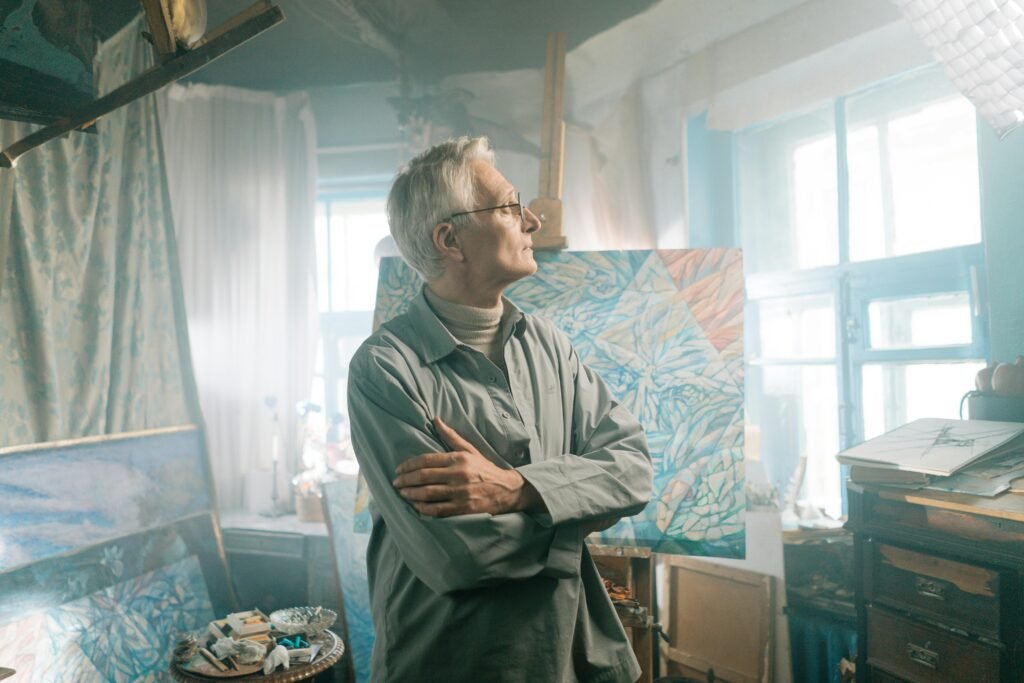
The ranch was far from the world he once ruled. Silence stretched across the fields like a question he could not answer. He sat before a blank canvas, brush in hand, thinking of the men.
Men who had gone to fight his wars. Men who had lost their homes, their families, their bodies, their youth. Men who came back to a world that did not understand the scars on their bodies, faces — or in their minds.
He had known power once. Felt it like fire in his veins. Words that could ignite nations. Decisions that sent young men to die. He had believed himself untouchable, brilliant, necessary. And yet, here he was — untitled, irrelevant — seeking a new kind of mastery. One of witness, not command.
The first man arrived quietly, eyes wary, body rigid. The artist’s hands shook as he lifted the brush, remembering the hands that had fought in his name. Each stroke was a question: could he capture the weight of their pain without diminishing it?
The man watched in silence, holding memories of battlefields, of screams, of brothers fallen. The artist felt the enormity of his own arrogance — the rivers of blood he had commanded — flowing not in distant lands but etched into the faces before him.
He painted in silence. And in that silence, the truth began to speak: the world he had ruled, the wars he had started, were not absolved by power. They were lived. Remembered. Endured. And now, in the quiet of this ranch, he could no longer hide behind titles, speeches, or victories. He could only witness.
Somewhere, deep inside, he wondered: how could men endure such lies, such betrayal — and still carry themselves with a dignity he had never known?
II. The First Conversation
The man finally spoke. His voice was low, steady, strangely calm.
“You’re the one who painted this war, aren’t you?”
The artist froze. Not because of the accusation, but because the truth in those words was a mirror he could not turn away from. He nodded, swallowing the weight of decades of arrogance and blood.
“I don’t know why I’m sitting here,” the man continued. “I could hate you. Maybe I should. But I’m tired of hating things I cannot change. I came because I wanted someone to see me.”
The artist lowered the brush. His hands — once steady enough to write decrees that reshaped nations — trembled now over a blank patch of canvas. He wanted to apologize. He wanted to justify. He wanted nothing yet wanted everything.
“I see you,” he whispered. Almost afraid the words would be stolen by the silence.
The man’s eyes softened. “Seeing isn’t enough. What I need is for someone to hold it with me. To remember it, so the world doesn’t forget what it cost.”
The artist understood, for the first time, that his mastery of power had never touched the hearts of those it affected. This was a different kind of power — fragile, slow, intimate. A power to hold. To witness. To honor.
They sat like that for hours. Brush strokes met canvas. Silence met confession. And somewhere between the paint and the stories, something strange began to bloom: a seed of responsibility, small and trembling, yet undeniable.
The war outside would never truly end. But here, in the quiet, the men who had lived it could tell their story. And the artist — for all his failings, all his arrogance — could finally listen.
III. The Arrival of More Survivors
Days passed. Sunlight slanted across the ranch in golden sheets, and with each dawn, another man arrived. Some limped. Some carried invisible scars no mirror could reflect. Some spoke; some only stared. But all of them came with the same quiet courage — the willingness to be seen.
The artist greeted each one in silence, watching, listening. With every brushstroke, he traced more than faces. He traced lives, pain, resilience, memory. Each canvas became a testament — a ledger of suffering that no government, no history book, could fully hold.
He began noticing patterns. The way men flinched at certain colors. The way a simple curve of the mouth betrayed decades of buried fear. The way hands that had once been strong with labor or combat now trembled from memories that refused to fade.
The more he painted, the more he felt the echo of his own actions — reverberating in muscles, in posture, in the set of their eyes.
Sometimes, in the quiet of night, he would sit outside and stare at the vast open land, brush and palette abandoned, and wonder: how did I believe I could hold a world in my hands — only to lose it all and realize I could never hold the souls of the men I sent to die?
But still, he painted. Still, they came. Still, he learned to make himself small before their stories — to let his arrogance dissolve like chalk dust in the wind.
And somewhere, amidst painting and silence, he began understanding art could not erase the past. But it could hold it. Honor it. Witness it. And in witnessing, perhaps, it could begin to bend the raw edges of grief toward something that looked — just barely — like redemption.
IV. Confrontation
One evening, the sky bruised purple and gold, a man stepped forward unlike the others.
He didn’t flinch. Didn’t sit quietly. His eyes held a storm — the kind carved by years of war.
“You sent us there, over lies” he said, voice tight, controlled. “You decided who lived and who died. Do you know what it feels like to watch your friends fall? To hear mothers wail? To look at your own body and not recognize it?”
The artist swallowed. Brush paused mid-air. All the powerful words he had once wielded like weapons deserted him. For the first time, there was no decree, no speech, no power to command or charm. Only truth.
“I know,” he said. Almost a whisper. “I know now. I didn’t understand then. But I see it now.”
The man let out a short, bitter laugh. “You see? You think seeing makes it right? You think painting our faces erases the blood, the fear, the stolen lives? We didn’t choose this. You did.”
The silence that followed was heavy, like a storm waiting to break. The artist felt the full weight of it — years compressed into a single moment. The absolute, inescapable truth of what he had caused.
“I can’t undo what I’ve done,” he admitted, voice raw. “But I can bear witness. I can see. I can remember. And maybe — in some small way — I can honor what you endured. That’s all I have left.”
The man studied him, searching for deceit, for arrogance, for hollow performance. He found none. Only someone stripped bare by their own guilt, attempting something unfamiliar: accountability.
Finally, the man nodded. Once. Sharply.
“Then paint me,” he said. “Not as a hero. Not as a victim. Just as me. Let the world see what it cost. Let them see everything.”
The artist dipped his brush, hand steady now, heart pounding. As the first stroke touched the canvas, he realized something he had never known in all his years of power: he was not in control. He was simply holding. Witnessing. Listening.
And that, somehow, might be enough.
There is a kind of reckoning that happens not in courtrooms or history books, but in the quiet spaces between two people — one who caused the wound, and one who carries it.
Witnessing is not absolution. It is not justice. But it may be the last honest thing a person can offer when everything else has been spent.
And sometimes, in the hands of those willing to truly see — even that is enough to begin.
Salima
Just me thinking out loud over here