
If you want to build a business that works, forget sales tactics for a moment. Go sit by a pond.
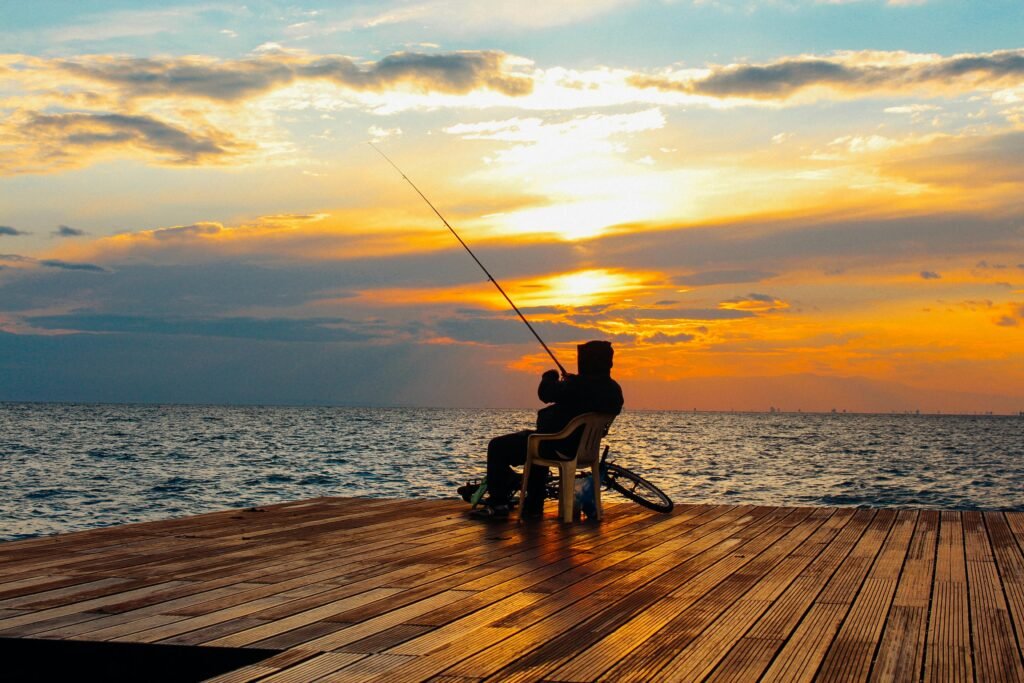
Imagine a man stepping out of his house on a quiet morning. The air is still. The only sound is birdsong and the distant shimmer of water. He is dressed casually — boots on his feet, a tackle box in one hand, a bucket of gear in the other. No rush. No noise. He knows exactly where he is going.
He walks to the pond, finds the deck, pulls up a chair, and takes his time assembling his rod. He ties on his lure — just the right one, chosen with care. Then he casts his line into the still water, leans back in his chair, and pulls the brim of his hat down over his eyes. He lights a cigarette. The smoke curls upward in the morning air. Calm. Silent. Patient. He is not chasing anything. He has already done the hard work. Now he waits for the fish to come to him.
Then — a sudden tug. A pull on the line. He knows immediately: he’s got one.
That man is the fisherman. And that, my friend, is exactly what business is.
The best businesses do not chase customers. They create something irresistible — the lure — and they wait for the right fish to bite.
Think about it. The fisherman doesn’t run into the water screaming and grab the fish with his hands. He studies what fish are in that pond. He figures out what they are hungry for. He crafts a lure that looks exactly like what they want. He places it right in their path, in the water they swim through every single day. And then he lets the fish do the rest of the work.
That is your business strategy. You are not selling. You are fishing.
Your lure — your offer, your content, your product, your brand — needs to be something people are hungry for. Something that stops them mid-swim. Something that makes them feel curious, seen, and pulled in, even when they weren’t looking for you. The fish didn’t know it was going to bite today. But it did. Because the lure was just right.
The day my sister and I became the fish
Let me tell you about the time we swam straight into someone else’s net.
A magazine reached out to us. They said they had come across our business online, loved what we were doing, and wanted to feature us in their next edition. Could we say yes?
Of course we said yes. We are a small business. Visibility is everything. Who turns down free exposure?
We did the interview. The article went live. And honestly? We felt proud. We thought, “This is for them to have an audience — and for us, a chance to be seen.” A win on both sides. We were the fishermen and they were… well, we thought we were both the fishermen.
Then the emails started coming. Every single day. And I won’t lie — part of me wanted what they were offering. They were asking us to purchase a framed press plate of our article, mounted and printed. The cheapest option was $219. And the email subject line? It was magnificent.
Their email — word for word
“The Most Visionary Woman Driving Innovation in Natural Skin Care and Wellbeing”
“As we are bound by our timeline and still have a vacant slot for this leading feature, we would like to offer you this advertising package at the exclusive cost of $900 USD…”
They made us feel special. Chosen. Like we were almost missing an opportunity if we didn’t act fast. That is not an accident. Every word was the lure. And we? We were the fish, already hooked from the moment we said yes to the first email.
Here is what I want you to notice: they were never just doing a magazine feature. They were casting a wide net into the ocean of small business owners, pulling in anyone who would bite on the promise of free visibility, and then monetising the catch. They went by the sea, threw their net, and waited to see which fish would swim into it. We did.
I respect the craft — even when it is used against people who deserve better. Because understanding how it works is the only way to protect yourself from it — and to use it honestly in your own business.
So, what does this mean for you?
Two things. Both matter equally.
First — learn to think like the fisherman.
🐟 Know your fish. Who are you trying to reach? What are they hungry for? What waters do they swim in? You cannot cast a lure before you answer this.
✨ Craft the right lure. Your offer must feel irresistible, not just useful. It needs to stop them mid-track and make them feel something — curiosity, recognition, desire.
⏰ Be patient. The fisherman doesn’t panic. He trusts his preparation. Good marketing takes time. Cast well, then wait.
👁 Place it in their path. The best lure in the wrong pond catches nothing. Be where your people already are — their feeds, their searches, their conversations.
Second — learn to recognize when you are the fish.
Not every lure is bad. Some offers are genuinely good for you — and you should take them. But slow down. Ask yourself: why is this free? What is the next step they want me to take? Who benefits most from this transaction? The fisherman is always calm, always patient, always in control. When someone is making you feel urgency, scarcity, and flattery all at once — look for the hook.
The smartest people in business are not the ones who never get caught. They are the ones who know exactly what pond they are swimming in.
My sister and I walked away from that magazine’s experience with something more valuable than a framed plate on our wall. We walked away with a masterclass in fishing.
We saw the patience. The flattery crafted like a lure. The timing of the hard sell. The urgency engineered to make you act before you think. And instead of feeling embarrassed, we felt educated.
Because now we know how to fish. Not by applying all the tactics in their playbook, some things are not for us but by using the mindset of the fisherman,
We know how to craft something our customers are genuinely hungry for. We know how to put it in the water the thing they need and wait. We know how to let the right people come to us — not because we chased them, but because what we built was worth biting.
Go build your lure. The pond is waiting.
Salima
Just me thinking out loud over here